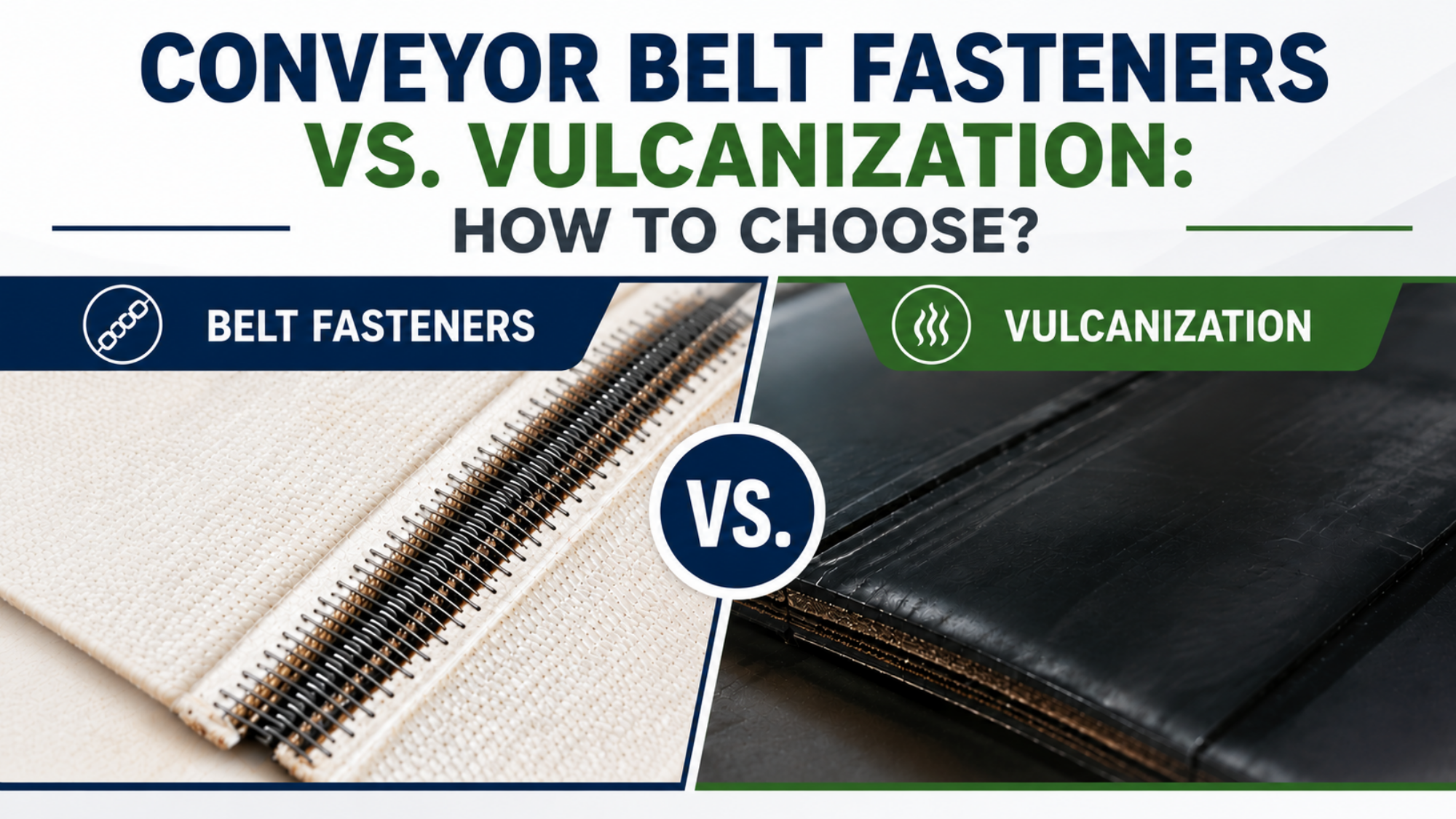
In modern material handling systems, conveyor belt fasteners and vulcanization are the two most widely used methods for joining conveyor belts. Choosing the wrong one can cripple your throughput, inflate your maintenance budget, and shorten your belt’s working life. This guide cuts through the complexity to help your business make the right call for the first time.
What Are Conveyor Belt Fasteners?
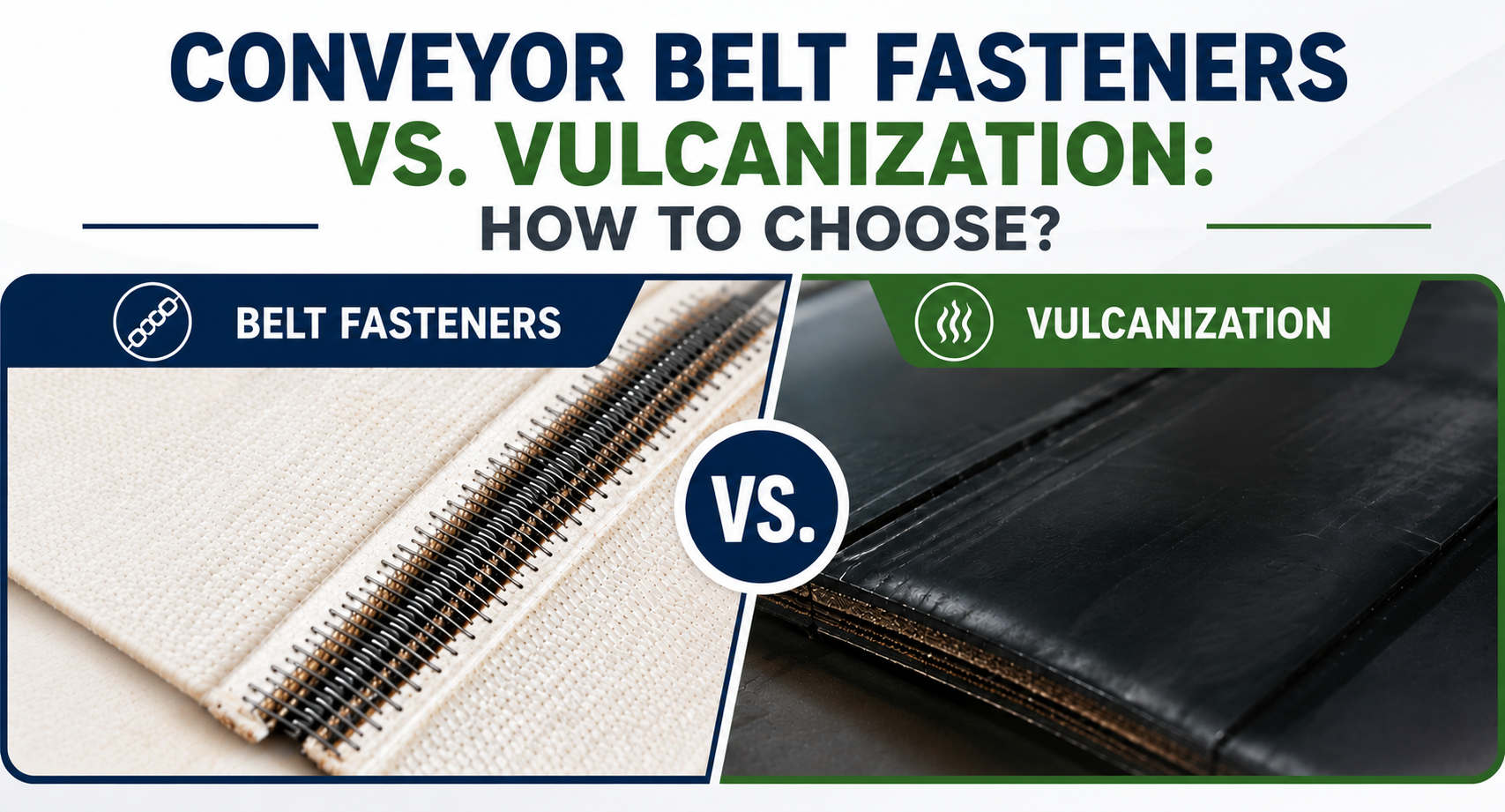
Conveyor belt fasteners are mechanical joining systems designed to connect the two ends of a conveyor belt without heat or chemical bonding. Instead of permanent fusion, they use metal or composite components to hold the belt together securely.
They are a go-to conveyor belt solution for operations that need speed, flexibility, and field-repairability.
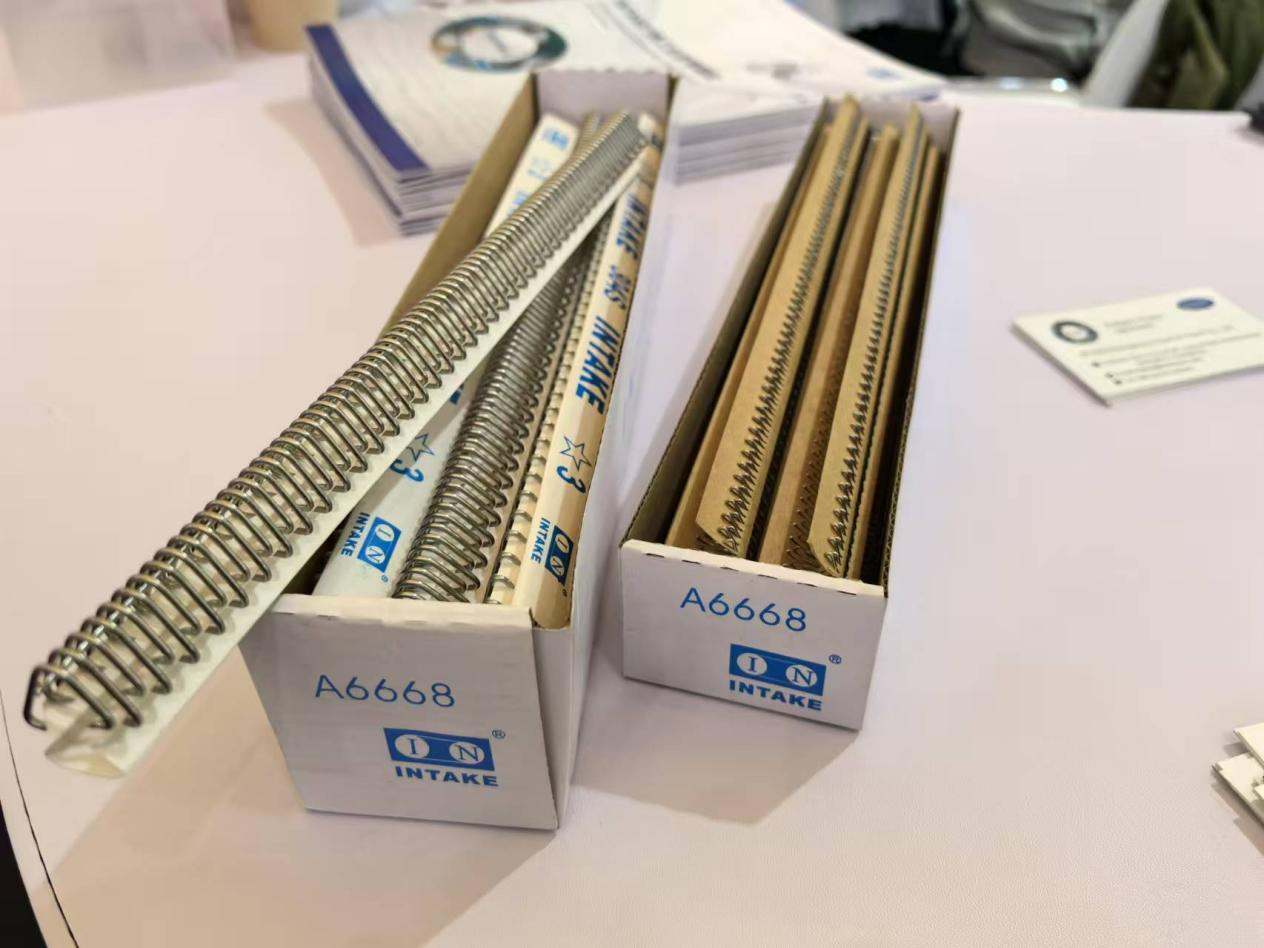
Common Types of Belt Fasteners
- Hinged fasteners: Interlocking hinge loops joined by a center pin. Ideal for medium-duty applications where the belt needs to be opened and closed repeatedly. Popular in logistics sorting lines and food processing.
- Solid plate fasteners: Heavy-duty metal plates that bolt across both belt ends. Designed for high-tension, high-load environments such as mining, corrugated paper production, and bulk material handling.
- Light-duty fasteners: Thin, low-profile options designed for lightweight or thin belts. Commonly used in laundry, textile, and eco-friendly polyester mesh belt applications where a flush surface matters.
Key Advantages of Conveyor Belt Fasteners
- Quick installation with minimal downtime
- Easy repair and replacement in the field
- Reusable components depending on design
- Flexible maintenance scheduling
What Is Vulcanization?
Vulcanization is a chemical bonding process that fuses the two ends of a conveyor belt using heat and pressure (hot vulcanization) or chemical adhesives (cold vulcanization). The result is a seamless, molecularly bonded joint that becomes part of the belt itself.
It is the preferred method when joint integrity and surface continuity are the top priorities.
Types of Vulcanized Joints
- Hot vulcanization: Uses a vulcanizing press to apply heat (140–160°C) and pressure for an extended curing period. Produces the strongest possible joint, closely matching the belt’s original tensile strength.
- Cold vulcanization: Uses chemical bonding agents and adhesives at ambient temperature. Faster than hot vulcanization, but generally produces a slightly weaker joint. Useful in environments where a press cannot be used.
Key Advantages of Vulcanization
- Smooth and seamless belt surface
- High tensile strength and load capacity
- Reduced noise and vibration during operation
- Better performance in high-speed applications
While vulcanization provides excellent structural integrity, it requires specialized tools, skilled technicians, and longer downtime during installation.
7 Factors to Compare Conveyor Belt Fasteners with Vulcanization
Choosing between conveyor belt fasteners and vulcanization depends on the following several factors:
1. Strength & Durability
Vulcanized joints offer superior tensile strength, making them better suited for high-tension systems carrying heavy loads. Conveyor belt fasteners, however, can handle demanding industrial loads while remaining serviceable in the field.
2. Downtime & Installation Speed
This is where conveyor belt fasteners win decisively. Mechanical installation takes several minutes. Vulcanization typically requires 4–8 hours of preparation, bonding, and curing, plus cooling time.
3. Cost Considerations
- Initial cost: Fasteners are significantly cheaper to purchase and install. Vulcanization requires specialized equipment, trained technicians, and consumables.
- Long-term cost: Vulcanized joints generally last longer between re-splicing, which can offset the higher upfront investment over time.
- Hidden costs: Every hour of unplanned downtime for vulcanization repair has a real dollar cost, often exceeding the hardware savings.
4. Technical Complexity
Vulcanization requires trained specialists and controlled conditions. Conveyor belt fasteners can be installed by maintenance staff with basic training and standard tools, reducing dependency on specialized contractors.
5. Maintenance Flexibility
Mechanical fasteners allow for on-the-fly adjustments, re-splicing, and belt length changes without cutting and discarding belt material. Vulcanized belts must be cut and re-spliced from scratch if adjustments are needed, which wastes belt material and time.
6. System Compatibility
Some belt types, particularly thin polyester mesh belts and lightweight textile belts, are not well-suited to vulcanization. The heat and pressure required can damage the belt’s structure. In these cases, conveyor belt fasteners are the safer, more compatible choice.
7. Environmental Suitability
Wet, chemical-heavy, or hygienic environments introduce challenges for both methods. Certain vulcanizing adhesives can degrade in wash-down conditions. Conversely, some fastener materials are susceptible to corrosion in aggressive chemical environments. Material selection matters for both methods.
Conveyor Belt Fasteners vs. Vulcanization: Beyond the Specs
1. The “Permanent vs. Practical” Trade-off
Vulcanization maximizes joint integrity, but it trades operational flexibility for raw strength. Conveyor belt fasteners optimize agility: faster repairs, lower barriers to maintenance, and the freedom to adjust belt length without scrapping material. The question is which method better fits your real-world operational rhythm.
2. The Hidden Cost of Downtime
In high-throughput logistics hubs and corrugated paper lines, production runs continuously. A vulcanization repair that takes 6 hours does not just cost the price of the splice, it costs 6 hours of lost output. In such cases, conveyor belt fasteners significantly reduce production losses compared to vulcanization.
3. The Cleanability Gap Often Gets Overlooked
For polyester mesh belts and laundry applications, belt hygiene is regulatory. Conveyor belt fasteners are specifically designed to minimize product catch points and pass wash-down protocols. Seamless vulcanized surfaces sound ideal in theory, but in practice, any surface imperfection in a vulcanized splice can become a contamination trap.
4. One Size Does Not Fit All
The optimal joint solution is application-specific, driven by belt type, load requirements, environmental conditions, maintenance capacity, and operational tempo. The most important step is to assess your priorities honestly, then match the method to your reality.
Choosing the Right Solution for Different Industries
| Industry | Recommended Solution | Reason |
| Express & Logistics | Conveyor belt fasteners | Fast repair and minimal downtime |
| Eco-Friendly Polyester Mesh Belts | Conveyor belt fasteners | Flexible maintenance and wash-down compatibility |
| Laundry & Textile | Conveyor belt fasteners | Easy cleaning and replacement cycles |
| Industrial Conveying | Vulcanization or hybrid | High load stability requirements |
| Corrugated Paper | Conveyor belt fasteners | Reduces production interruption costs |
FAQs
1. Which conveyor belt joint method lasts longer overall?
Vulcanized joints generally have a longer service life when properly executed, as the bond integrates with the belt material itself. However, conveyor belt fastener suppliers like Intake offer competitive service life.
2. How often do fasteners need replacement compared to vulcanized joints?
This depends heavily on operating conditions, belt speed, and load. In moderate-duty applications, mechanical fasteners can last 6–18 months before requiring attention.
3. Which method is better for wet or chemical-heavy environments?
Stainless steel or coated mechanical fasteners are often the better choice in wet or chemically aggressive environments. Some vulcanizing adhesives can break down under prolonged exposure to water, oils, or cleaning chemicals.
4. Can a vulcanized belt be repaired if the splice fails?
Yes, but it requires cutting out the failed splice, re-preparing the belt ends, and performing a new vulcanization. This process takes hours and requires the same specialized equipment as the original splice.
5. Which option offers lower total operating costs?
It depends on your operation. For high-frequency, 24/7 lines where downtime is expensive, conveyor belt fasteners often deliver the lower total operating cost. For slower-moving, heavy-load systems with infrequent maintenance windows, vulcanization’s longer service life may tip the balance.
Conclusion
There is no universal winner between vulcanization and conveyor belt fasteners. The best joining method depends on your operational priorities, your belt type, your environment, and the maintenance resources you actually have available.
If you are still hesitate to which one to choose, contact us right now. Whether you are selecting a joining method for a new line or re-evaluating your current approach, our technical team is ready to help you find the right fit.